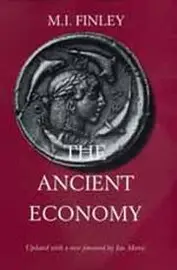
The ancient economy
M. I. Finley · 1973
Politics, economics and society › Classical economics and free markets
#7,115 most recommended
Hacker News
5
mentions by 5 people · top 48% of 15,732 books
Open Library
4.00★★★★★★★★★★
1 rating · 29 want to read
Wikipedia
455
article views a month
About the book
A study of economic life in the ancient Mediterranean world, chiefly Greece and Rome, covering agriculture, land tenure, slavery, debt, trade, money and the role of cities. It is built from connected essays rather than a single continuous narrative. Finley contends that ancient economies cannot be understood through modern economic categories such as self-regulating markets, capital investment or sustained growth, because production and exchange were embedded in status, kinship, politics and landholding. He argues that land was the principal source of wealth and prestige, that elites spent their surpluses on consumption and display rather than productive investment, and that trade and money were real but did not integrate the wider economy into a market system. He also challenges scholars who treat the ancient world as a miniature version of the modern one, and asks for more precise, source-critical reasoning about ancient economic behaviour.
Written by Claude from what it knows of this book.
What Hacker News says 20% recommend · 0% critical
In the commenters’ own words
Communists actually do say that. Marx called it "primitive communism". The trend in economic history has been the opposite of what you say. In the 70s it was…
Before 1800, and especially before 1500, the monetary economy was so small, and the barter economy was so large, that these economies did not have recessions…
What Open Library readers say 4.00 from 1 rating
- 50
- 41
- 30
- 20
- 10
- 29 want to read
- 0 reading
- 2 have read
Only 1 rating: treat the average as a hint.
What Wikipedia says
- published 1973
- 222 pages
- articles in 3 languages
Reddit communities — coming later
Details
- First published
- 1973
- ISBN
- 9780520219465
- Editions known
- 12 at Open Library
- Open Library
- OL890162W
Ancient CivilizationAntiquitéChild PsychologyCivilization, ancientEconomic conditionsEconomic historyEconomics, historyGrowthHistoire économiqueLand tenureWirtschaft
Read next: its neighbours on the mosaic
 The wheels of commerceFernand Braudel · 1982 · recommended by 2 people · similar by subject and what people say about it
 The structures of everyday lifeFernand Braudel · 1981 · recommended by 7 people · similar by subject and what people say about it
 Rise and Fall of American GrowthRobert J. Gordon · 2016 · recommended by 24 people · loosely similar by subject
 Civilization and Capitalism, 15th-18th CenturyFernand Braudel · 1982 · recommended by 4 people · similar by subject and what people say about it
 Money Changes EverythingWilliam N. Goetzmann · 2016 · recommended by 3 people · similar by subject and what people say about it
 The overworked AmericanJuliet Schor · 1991 · recommended by 4 people · loosely similar by subject
 The moral basis of a backward societyEdward C. Banfield · 1958 · recommended by 3 people · loosely similar by subject
 The Road to SerfdomFriedrich A. von Hayek · 1944 · recommended by 59 people · similar by subject and what people say about it
 The worldly philosophersRobert L. Heilbroner · 1953 · recommended by 17 people · similar by subject and what people say about it
 Stone age economicsMarshall Sahlins · 1972 · recommended by 3 people · similar by subject and what people say about it
 The Seleukid Royal EconomyG. G. Aperghis · 2000 · recommended by 1 person · similar by subject and what people say about it
 The great resetRichard Florida · 2010 · recommended by 2 people · loosely similar by subject
 The Roman revolutionRonald Syme · recommended by 0 people · similar by subject and what people say about it
 Global Economic HistoryRobert C. Allen · 2011 · recommended by 1 person · similar by subject and what people say about it
 History of Economic AnalysisJoseph Alois Schumpeter · 1954 · recommended by 1 person · similar by subject and what people say about it
 The Great TransformationKarl Polanyi · 1944 · recommended by 12 people · similar by subject and what people say about it
 Principles of Political EconomyJohn Stuart Mill · 1848 · recommended by 0 people · similar by subject and what people say about it
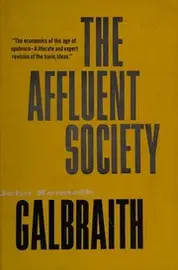 The affluent societyJohn Kenneth Galbraith · 1958 · recommended by 11 people · similar by subject and what people say about it
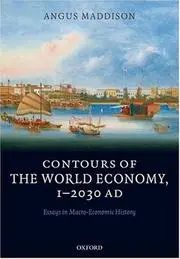 Contours of the World Economy 1-2030 ADAngus Maddison · 2007 · recommended by 1 person · similar by subject and what people say about it
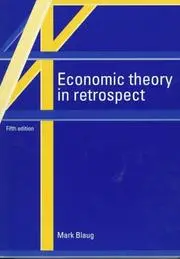 Economic theory in retrospectMark Blaug · 1962 · recommended by 3 people · similar by subject and what people say about it
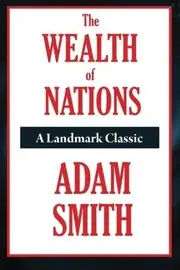 The Wealth of NationsAdam Smith · 1776 · recommended by 92 people · similar by subject and what people say about it
 A history of interest ratesSidney Homer · 1963 · recommended by 3 people · similar by subject and what people say about it
 Economic Facts and FallaciesThomas Sowell · 2007 · recommended by 8 people · similar by subject and what people say about it
 The lever of richesJoel Mokyr · 1990 · recommended by 7 people · similar by subject and what people say about it