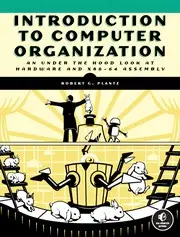
Introduction to Computer Organization
Bob Plantz · 2019
Programming and computer science › Electronics and computer architecture
#6,287 most recommended
Hacker News
6
mentions by 6 people · top 42% of 15,732 books
Open Library
—
No ratings yet
3 want to read
Wikipedia
—
No article yet
About the book
An introductory textbook on how computers are organized at the hardware-software boundary. It covers number representation, digital logic, the basic components of a processor and memory system, and how programs are executed at the machine level. The examples use ARM assembly language. The book holds that a programmer who understands how data, instructions, and memory are represented and moved inside the machine can write more reliable and efficient low-level code. It presents assembly language as the most direct way to see that connection, and it builds from logic gates and binary arithmetic up to small working programs. Its main claim is that organization and programming should be learned together rather than separately.
Written by Claude from what it knows of this book.
What Hacker News says 33% recommend · 0% critical
In the commenters’ own words
Things like the stack and heap and many other things (like memory mapped I/O, interrupts, etc) are often taught in first year university courses under a name…
Focusing on x86-64 (don't waste your time starting with the 32-bit variant when learning, let alone x87 FPU instructions, there's plenty of up-to-date…
What Open Library readers say
No Open Library reader has rated it yet.
- 3 want to read
- 0 reading
- 0 have read
What critics say, via Wikipedia
No Wikipedia article about this book yet, so no critics to quote.
Reddit communities — coming later
Details
- First published
- 2019
- ISBN
- 9781718500099
- Editions known
- 2 at Open Library
- Open Library
- OL21217236W
Read next: its neighbours on the mosaic
 ARM Assembly languageWilliam Hohl · 2009 · recommended by 3 people · similar by subject and what people say about it
 Modern X86 Assembly Language ProgrammingDaniel Kusswurm · 2018 · recommended by 2 people · similar by subject and what people say about it
 Programming with 64-Bit ARM Assembly LanguageStephen Smith · 2020 · recommended by 1 person · similar by subject and what people say about it
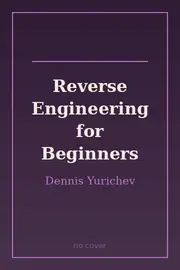 Reverse Engineering for BeginnersDennis Yurichev · 2013 · recommended by 23 people · similar by subject and what people say about it
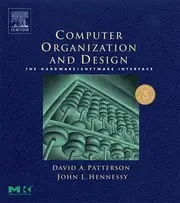 Computer organization and designDavid A. Patterson · 2004 · recommended by 50 people · similar by subject and what people say about it
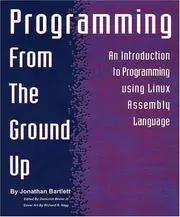 Programming from the Ground UpJonathan Bartlett · 2009 · recommended by 36 people · similar by subject and what people say about it
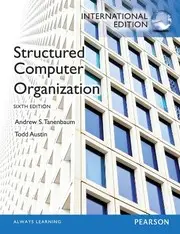 Structured Computer OrganizationAndrew S. Tanenbaum · 1975 · recommended by 21 people · similar by subject and what people say about it
 Computation structuresStephen A. Ward · 1990 · recommended by 8 people · similar by subject and what people say about it
 Computer Organization and Design RISC-V EditionDavid A. Patterson · 2017 · recommended by 6 people · similar by subject and what people say about it
 Introduction to Computing SystemsYale N. Patt · 2003 · recommended by 4 people · similar by subject and what people say about it
 Computer organization and architectureWilliam Stallings · 1987 · recommended by 3 people · similar by subject and what people say about it
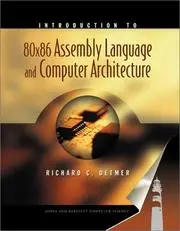 Introduction to 80x86 assembly language and computer architectureRichard C. Detmer · 2001 · recommended by 2 people · similar by subject and what people say about it
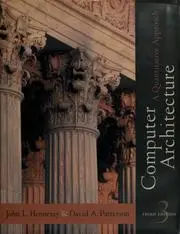 Computer architectureJohn L. Hennessy · 1989 · recommended by 59 people · similar by subject and what people say about it
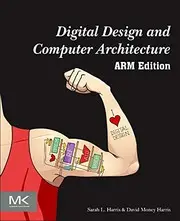 Digital Design and Computer ArchitectureSarah Harris · 2010 · recommended by 26 people · similar by subject and what people say about it
 Lessons in Electric CircuitsTony R. Kuphaldt · 2000 · recommended by 15 people · similar by subject and what people say about it
 The art of Assembly languageRandall Hyde · 2003 · recommended by 18 people · similar by subject and what people say about it
 Assembly Language Step-by-stepJeff Duntemann · 2000 · recommended by 19 people · similar by subject and what people say about it
 Computer system architectureM. Morris Mano · recommended by 6 people · similar by subject and what people say about it
 Assembly Language for x86 ProcessorsKip R. Irvine · 2014 · recommended by 2 people · similar by subject and what people say about it
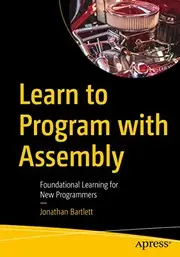 Learn to Program with AssemblyJonathan Bartlett · 2021 · recommended by 4 people · similar by subject and what people say about it
 Introduction to 64 Bit Assembly Programming for Linux and OS XRay Seyfarth · 2014 · recommended by 1 person · similar by subject and what people say about it
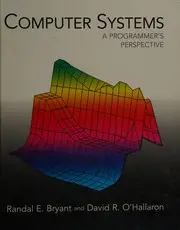 Computer systemsRandal Bryant · 2002 · recommended by 67 people · similar by subject and what people say about it
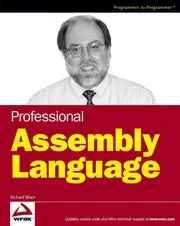 Professional assembly languageRichard Blum · 2005 · recommended by 5 people · similar by subject and what people say about it
 Introduction to 64 Bit Intel Assembly Language Programming for LinuxRay Seyfarth · 2011 · recommended by 2 people · similar by subject and what people say about it