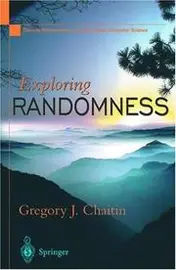
Exploring randomness
Gregory J. Chaitin · 2001
Mathematics and physics › Infinity and logic for general readers
#13,996 most recommended
Hacker News
2
mentions by 2 people · top 79% of 15,732 books
Open Library
—
No ratings yet
3 want to read
Wikipedia
—
No article yet
About the book
The subject is algorithmic information theory, which measures the complexity of a string by the size of the shortest program that produces it. The book is an informal, lecture-style exposition that uses small LISP programs as its working language and draws on computability, information theory and the foundations of mathematics. Its scope is the mathematics of randomness and the limits of formal reasoning rather than practical computing. Chaitin argues that randomness is not confined to physics or probability but appears inside pure mathematics, so some arithmetical facts cannot be compressed or derived from any finite set of axioms. His main example is the halting probability Omega, a real number whose binary digits are algorithmically random and can be defined but not computed. From this he claims that incompleteness follows from information content: a formal system with a given amount of information can settle only finitely many of Omega's digits.
Written by Claude from what it knows of this book.
What Hacker News says 100% recommend · 0% critical
In the commenters’ own words
For anyone who might be misled, here are some links that people can use to judge for themselves how "crank" someone is: Professor Norman Wildberger's…
Anything by https://en.wikipedia.org/wiki/Gregory_Chaitin , for example https://www.amazon.com/Exploring-Randomness-Discrete-Mathema... .
What Open Library readers say
No Open Library reader has rated it yet.
- 3 want to read
- 0 reading
- 0 have read
What critics say, via Wikipedia
No Wikipedia article about this book yet, so no critics to quote.
Reddit communities — coming later
Details
- First published
- 2001
- ISBN
- 9781852334178
- Editions known
- 6 at Open Library
- Open Library
- OL17946004W
Computational complexityLISP (Computer program language)Machine theory
Read next: its neighbours on the mosaic
 Meta Math!Gregory Chaitin · 2005 · recommended by 11 people · similar by subject and what people say about it
 Turtles, termites, and traffic jamsMitchel Resnick · 1994 · recommended by 9 people · loosely similar by subject
 Meta mathsGregory J. Chaitin · 2006 · recommended by 1 person · similar by subject and what people say about it
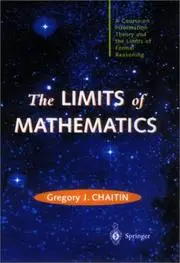 The Limits of MathematicsGregory J. Chaitin · 1997 · recommended by 2 people · similar by subject and what people say about it
 The Mathematical ExperiencePhilip J. Davis · 1980 · recommended by 20 people · 2 people recommended both
 Algorithmic information theoryGregory J. Chaitin · 1987 · recommended by 1 person · similar by subject and what people say about it
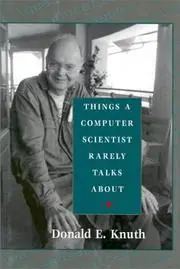 Things a Computer Scientist Rarely Talks AboutDonald Knuth · 2001 · recommended by 9 people · similar by subject and what people say about it
 Probability TheoryE. T. Jaynes · 2003 · recommended by 77 people · similar by subject and what people say about it
 Why people believe weird thingsMichael Shermer · 1997 · recommended by 9 people · loosely similar by subject
 Turtle geometryHarold Abelson · 1981 · recommended by 15 people · loosely similar by subject
 ChaosJames Gleick · 1987 · recommended by 45 people · similar by subject and what people say about it
 Godel's theorem simplifiedHarry J. Gensler · 1984 · recommended by 2 people · loosely similar by subject
 An introduction to information theoryJohn Robinson Pierce · 1980 · recommended by 15 people · similar by subject and what people say about it
 The craft of PrologRichard A. O'Keefe · 1990 · recommended by 18 people · loosely similar by subject
 Theory of computationMichael Sipser · 2007 · recommended by 14 people · similar by subject and what people say about it
 Chance and chaosDavid Ruelle · 1991 · recommended by 3 people · similar by subject and what people say about it
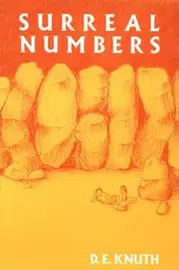 Surreal numbersDonald Knuth · 1974 · recommended by 27 people · similar by subject and what people say about it
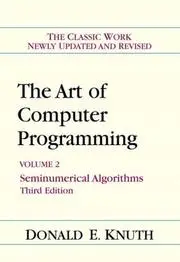 The art of computer programmingDonald Knuth · 1968 · recommended by 336 people · similar by subject and what people say about it
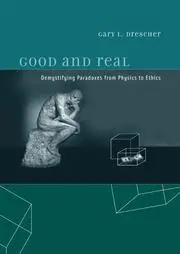 Good and realGary L. Drescher · 2006 · recommended by 8 people · similar by subject and what people say about it
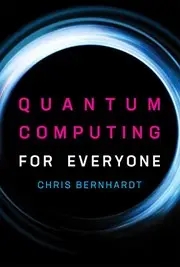 Quantum Computing for EveryoneChris Bernhardt · 2019 · recommended by 3 people · similar by subject and what people say about it
 Does God play dice?Ian Stewart · 1989 · recommended by 1 person · similar by subject and what people say about it
 Chaos and fractalsHeinz-Otto Peitgen · 1992 · recommended by 4 people · similar by subject and what people say about it
 Proofs and refutationsImre Lakatos · 1976 · recommended by 34 people · similar by subject and what people say about it
 The logic of chanceEugene V. Koonin · 2011 · recommended by 2 people · similar by subject and what people say about it