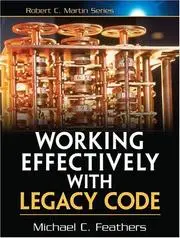
Working effectively with legacy code
Michael C. Feathers · 2004
Programming and computer science › Testing and legacy code
#108 most recommended
Hacker News
315
mentions by 234 people · top 0.7% of 15,732 books
Open Library
4.00★★★★★★★★★★
7 ratings · 67 want to read
Wikipedia
—
No article yet
About the book
Working Effectively with Legacy Code covers how to change existing software that was written without tests, which Feathers defines as legacy code. Its scope is the practical work of making that code safe to modify: understanding what it does, adding tests around it, and restructuring it in small steps. Feathers's central claim is that legacy code can be changed safely if you first get it under test, even when the code is tightly coupled and hard to test. The main technique is to find seams, places where behaviour can be altered without editing the code at that point, and to use them to break dependencies. Characterization tests record what the code currently does so that refactoring can proceed without changing behaviour. The book presents a catalogue of these dependency-breaking techniques and argues that disciplined, incremental refactoring under test is more reliable than rewriting.
Written by Claude from what it knows of this book.
What Hacker News says 79% recommend · 1% critical
In the commenters’ own words
I really disagree about damage to our industry over the last 10 or 20 (or 30) years. But I haven't deeply considered such a topic. I have thought a bit about…
You don't have a software problem, you have a people problem. You have some directly measurable consequences of the underlying issues, as well as some obvious…
What Open Library readers say 4.00 from 7 ratings
- 51
- 45
- 31
- 20
- 10
- 67 want to read
- 5 reading
- 12 have read
Only 7 ratings: treat the average as a hint.
What critics say, via Wikipedia
No Wikipedia article about this book yet, so no critics to quote.
Reddit communities — coming later
The threads it came up in
- Ask HN: Books you read in 2016?
- Ask HN: Books you plan to read in 2020?
- Ask HN: Which book are you reading these days?
- Ask HN: Which books you have read till now that were worth investing time in?
- Ask HN: What language-agnostic programming books should I read?
- Ask HN: What books do you keep on your desk?
- Ask HN: Name 3-5 books that had the most impact on your career and knowledge?
- Ask HN: What's the best programming book you've read recently?
Details
- First published
- 2004
- ISBN
- 9780131177055
- Editions known
- 6 at Open Library
- Open Library
- OL5742702W
005.1Application softwareApplication software, developmentApplication software--developmentDevelopmentQa76.76.a65 f43 2005
Read next: its neighbours on the mosaic
 Clean CodeRobert C. Martin · 2008 · recommended by 298 people · 26 people recommended both
 Growing object-oriented software, guided by testsSteve Freeman · 2010 · recommended by 43 people · 6 people recommended both
 Test-driven developmentKent Beck · 2002 · recommended by 30 people · 5 people recommended both
 Domain-Driven DesignEric Evans · 2003 · recommended by 104 people · 14 people recommended both
 Code CompleteSteve McConnell · 1993 · recommended by 393 people · 18 people recommended both
 Extreme programming explainedKent Beck · 1999 · recommended by 23 people · 6 people recommended both
 The clean coderRobert C. Martin · 2011 · recommended by 53 people · 8 people recommended both
 Patterns of Enterprise Application ArchitectureMartin Fowler · 2002 · recommended by 34 people · 6 people recommended both
 Refactoring to PatternsJoshua Kerievsky · 2004 · recommended by 15 people · 3 people recommended both
 A Philosophy of Software DesignJohn K. Ousterhout · 2018 · recommended by 163 people · 10 people recommended both
 The art of unit testingRoy Osherove · 2009 · recommended by 12 people · 3 people recommended both
 The art of agile developmentJames Shore · 2007 · recommended by 13 people · 3 people recommended both
 The Mythical Man-MonthFrederick P. Brooks · 1975 · recommended by 383 people · 15 people recommended both
 The Pragmatic ProgrammerAndy Hunt · 1999 · recommended by 353 people · 14 people recommended both
 Making SoftwareAndy Oram · 2010 · recommended by 12 people · similar by subject and what people say about it
 Agile Software Development, Principles, Patterns, and PracticesRobert C. Martin · 2002 · recommended by 7 people · 2 people recommended both
 Clean ArchitectureRobert C. Martin · 2017 · recommended by 47 people · 4 people recommended both
 XUnit Test PatternsGerard Meszaros · 2007 · recommended by 5 people · 2 people recommended both
 The passionate programmerChad Fowler · 2011 · recommended by 31 people · 5 people recommended both
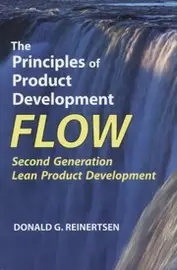 The Principles of Product Development FlowDonald G. Reinertsen · 2009 · recommended by 44 people · 4 people recommended both
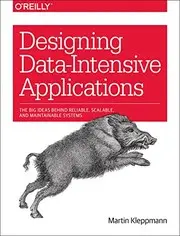 Designing Data-Intensive ApplicationsMartin Kleppmann · 2017 · recommended by 457 people · 10 people recommended both
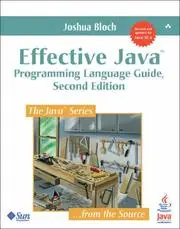 Effective JavaJoshua Bloch · 2001 · recommended by 172 people · 5 people recommended both
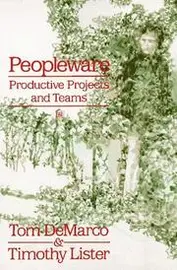 PeoplewareTom DeMarco · 1987 · recommended by 276 people · 10 people recommended both
 The psychology of computer programmingGerald M. Weinberg · 1971 · recommended by 44 people · 6 people recommended both