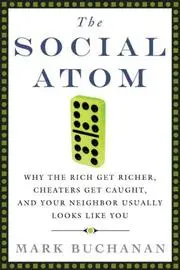
The social atom
Mark Buchanan · 2007
Politics, economics and society › Class and inequality
#13,850 most recommended
Hacker News
2
mentions by 2 people · top 79% of 15,732 books
Open Library
4.00★★★★★★★★★★
1 rating · 2 want to read
Wikipedia
—
No article yet
About the book
The book examines collective human behavior through the lens of statistical physics and network science, covering how patterns in social life emerge from many people's local interactions. Its scope takes in neighborhoods, social networks, markets, and ethnic clustering, and it draws on examples from sociology, economics, and computer modeling. Its central claim is that large-scale social patterns, such as segregation, inequality, and the spread of ideas or behavior, often arise from the structure of interactions rather than from the intentions of individuals. It argues that mild individual preferences can produce strong collective sorting, as in segregation models, and that networks which grow by favoring already well-connected nodes tend to produce highly unequal distributions. It also suggests that cooperation and the detection of cheating depend on who is connected to whom, so social order can be understood statistically.
Written by Claude from what it knows of this book.
What Hacker News says 100% recommend · 0% critical
In the commenters’ own words
Mathematical economist/game theorist here (applying daily in the role of CEO of family firm founded three generations ago). Firstly... and I do not mean this…
Instead of wasting time on a (rather biased) critique, read the original paper: "Talent vs Luck: the role of randomness in success and failure" by A…
What Open Library readers say 4.00 from 1 rating
- 50
- 41
- 30
- 20
- 10
- 2 want to read
- 0 reading
- 1 have read
Only 1 rating: treat the average as a hint.
What critics say, via Wikipedia
No Wikipedia article about this book yet, so no critics to quote.
Reddit communities — coming later
Details
- First published
- 2007
- ISBN
- 9781596910133
- Editions known
- 2 at Open Library
- Open Library
- OL5820379W
Collective behaviorEthnic relationsEtniska relationerMasspsykologiSegregation
Read next: its neighbours on the mosaic
 Social media is bullshitB. J. Mendelson · 2012 · recommended by 1 person · loosely similar by subject
 Origin of WealthEric D. Beinhocker · 2006 · recommended by 15 people · loosely similar by subject
 AntifragileNassim Nicholas Taleb · 2012 · recommended by 135 people · 2 people recommended both
 The Big Book of ConceptsGregory L. Murphy · 2004 · recommended by 3 people · loosely similar by subject
 The crowd a study of the popular mindGustave Le Bon · 1960 · recommended by 6 people · loosely similar by subject
 The Conscience of a LiberalPaul R. Krugman · 2006 · recommended by 2 people · loosely similar by subject
 NexusMark Buchanan · 2002 · recommended by 4 people · similar by subject and what people say about it
 Mindf*ckChristopher Wylie · 2019 · recommended by 4 people · loosely similar by subject
 The Model ThinkerScott E. Page · 2018 · recommended by 9 people · loosely similar by subject
 The Myth of the Rational MarketJustin Fox · 2008 · recommended by 4 people · loosely similar by subject
 Why They KillRichard Rhodes · 1999 · recommended by 2 people · loosely similar by subject
 Human DiversityCharles Murray · 2020 · recommended by 1 person · loosely similar by subject
 On Being CertainRobert A. Burton · 2008 · recommended by 2 people · loosely similar by subject
 Moral Tribes Emotion Reason And The Gap Between Us And ThemJoshua Greene · 2014 · recommended by 2 people · loosely similar by subject
 The social animalElliot Aronson · 1972 · recommended by 6 people · loosely similar by subject
 Hello worldHannah Fry · 2018 · recommended by 5 people · loosely similar by subject
 Micromotives and MacrobehaviorThomas C. Schelling · 1978 · recommended by 3 people · loosely similar by subject
 The Art of ProbabilityRichard Hamming · 1990 · recommended by 7 people · loosely similar by subject
 The architecture of symbolic computersPeter M. Kogge · 1991 · recommended by 6 people · loosely similar by subject
 Why stock markets crashD. Sornette · 2003 · recommended by 5 people · loosely similar by subject
 Where Does Money Come From?Josh Ryan-Collins · 2017 · recommended by 5 people · loosely similar by subject
 WrongDavid H. Freedman · 2010 · recommended by 6 people · loosely similar by subject
 Mathematics of Physics and Modern EngineeringIvan Stephen Sokolnikoff · 1958 · recommended by 1 person · loosely similar by subject
 Women, fire, and dangerous thingsGeorge Lakoff · 1987 · recommended by 10 people · loosely similar by subject