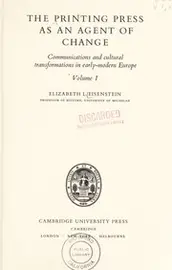
The printing press as an agent of change
Elizabeth L. Eisenstein · 1979
Politics, economics and society › Media and technology criticism
#3,253 most recommended
Hacker News
32
mentions by 7 people · top 11% of 15,732 books
Open Library
4.00★★★★★★★★★★
3 ratings · 24 want to read
Wikipedia
—
No article yet
About the book
A study of how movable-type printing, introduced in Europe around 1450, changed the production, preservation, and circulation of texts and images. It covers roughly the early modern period, from the fifteenth century into the eighteenth, and focuses mainly on Western Europe. Eisenstein holds that print was more than a faster way to copy manuscripts. Its fixity, uniformity, and capacity for multiplication altered how texts were corrected, compared, cited, and accumulated, which made possible a more cumulative body of learning. She treats print as a catalyst that helped shape Renaissance humanism, the Reformation, and the scientific revolution, rather than as their sole cause.
Written by Claude from what it knows of this book.
What Hacker News says 71% recommend · 0% critical
In the commenters’ own words
My own thinking on this has evolved very considerably over the past five years or so. That's included a comprehensive and ongoing exploration of the fields of…
The trend was well underway in the mid-aughts, though some might argue that early forum systems, including Slashdot (Slashcode), phpBB, and even AOL forums…
What Open Library readers say 4.00 from 3 ratings
- 50
- 43
- 30
- 20
- 10
- 24 want to read
- 3 reading
- 3 have read
Only 3 ratings: treat the average as a hint.
What critics say, via Wikipedia
No Wikipedia article about this book yet, so no critics to quote.
Reddit communities — coming later
The threads it came up in
Details
- First published
- 1979
- ISBN
- 9780521299558
- Editions known
- 12 at Open Library
- Open Library
- OL3610191W
BoekdrukkunstCivilizationCultuurveranderingHistoryImprimerieInfluencePrintingPrinting pressesPrinting, historyReformationRenaissanceRéforme (Christianisme)Technologie et civilisationTechnology
Read next: its neighbours on the mosaic
 The Gutenberg GalaxyMarshall McLuhan · 1962 · recommended by 8 people · named together in 7 comments
 The control revolutionAndrew L. Shapiro · 1999 · recommended by 2 people · loosely similar by subject
 The Future of IdeasLawrence Lessig · 2001 · recommended by 1 person · loosely similar by subject
 The control revolutionJames R. Beniger · 1986 · recommended by 3 people · named together in 2 comments
 The art of doing science and engineeringRichard Hamming · 1996 · recommended by 56 people · 2 people recommended both
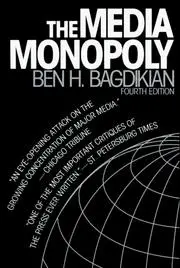 The media monopolyBen H. Bagdikian · 1983 · recommended by 1 person · loosely similar by subject
 The Open Society and Its EnemiesKarl Popper · 1945 · recommended by 31 people · loosely similar by subject
 News from nowhereEdward Jay Epstein · 1973 · recommended by 1 person · loosely similar by subject
 A history of technologyCharles Singer · 1954 · recommended by 2 people · loosely similar by subject
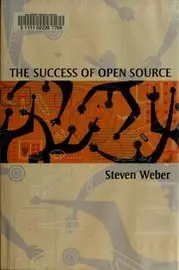 The success of open sourceSteve Weber · 2004 · recommended by 1 person · loosely similar by subject
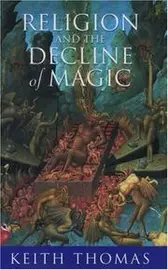 Religion and the Decline of MagicKeith Thomas · 1971 · recommended by 2 people · loosely similar by subject
 The medium is the messageMarshall McLuhan · 1967 · recommended by 5 people · loosely similar by subject
 Reinventing FireAmory B. Lovins · 2011 · recommended by 2 people · loosely similar by subject
 Orality and LiteracyWalter J. Ong · 1982 · recommended by 9 people · loosely similar by subject
 Galileo, courtierMario Biagioli · 1993 · recommended by 1 person · loosely similar by subject
 The taming of chanceIan Hacking · 1990 · recommended by 3 people · loosely similar by subject
 Before European HegemonyJanet L. Abu-Lughod · 1989 · recommended by 1 person · loosely similar by subject
 The medieval machineJean Gimpel · 1975 · recommended by 3 people · similar by subject and what people say about it
 Information rulesCarl Shapiro · 1999 · recommended by 18 people · 2 people recommended both
 The economy of citiesJane Jacobs · 1969 · recommended by 4 people · loosely similar by subject
 The influencing machineBrooke Gladstone · 2011 · recommended by 1 person · similar by subject and what people say about it
 Ideas that changed the worldFelipe Fernández-Armesto · 2003 · recommended by 0 people · similar by subject and what people say about it
 The Capitalism PapersJerry Mander · 2012 · recommended by 1 person · loosely similar by subject
 The nature of technologyW. Brian Arthur · 2009 · recommended by 4 people · loosely similar by subject