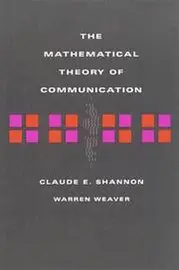
The mathematical theory of communication
Claude Elwood Shannon · 1949
Minds, machines and the future › Information theory and chaos
#350 most recommended
Hacker News
118
mentions by 103 people · top 3% of 15,732 books
Open Library
—
No ratings yet
33 want to read
Wikipedia
3,968
article views a month
About the book
A mathematical framework for communication systems, treating information as a measurable quantity that can be sent through a channel. It covers discrete sources and channels, both noiseless and noisy, along with the extension to continuous signals, and the 1949 edition adds an interpretive introduction by Warren Weaver that places the technical results alongside questions of meaning and effectiveness. Communication can be analyzed as a statistical problem whose central task is reproducing a message at another point, with the meaning of the message set aside. The uncertainty of a source, measured as entropy, sets how much information it produces and how far its output can be compressed without loss. Over a noisy channel, a quantity called capacity marks the highest rate at which information can be sent, and coding can make the error rate arbitrarily small at any rate below that limit.
Written by Claude from what it knows of this book.
What Hacker News says 46% recommend · 0% critical
In the commenters’ own words
This is something that I've struggled with myself so I can only give you advice as I've learned it from my perspective. Math is a big field so you have to…
MIT is publishing a book that collects these classic papers: Prior Analytics (∼350 BCE) By Aristotle The True Method (1677) By Gottfried Wilhelm Leibniz…
What Open Library readers say
No Open Library reader has rated it yet.
- 33 want to read
- 2 reading
- 1 have read
What Wikipedia says
- published 1948
- articles in 16 languages
- 3,968 views a month
Reddit communities — coming later
The threads it came up in
Details
- First published
- 1949
- ISBN
- 9780252725487
- Editions known
- 2 at Open Library
- Open Library
- OL2296213W
CommunicationInformation theoryLong Now Manual for CivilizationMathematical modelsMathematical physicsMathematics, historyTelecommunication
Read next: its neighbours on the mosaic
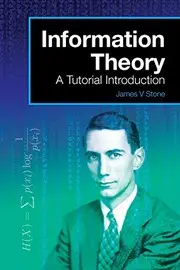 Information TheoryJames V Stone · 2015 · recommended by 2 people · similar by subject and what people say about it
 Logic of InformationLuciano Floridi · 2019 · recommended by 1 person · similar by subject and what people say about it
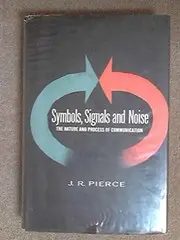 Symbols, signals, and noiseJohn R. Pierce · 1961 · recommended by 12 people · similar by subject and what people say about it
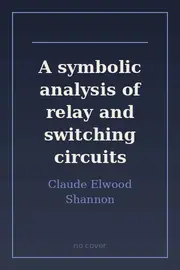 A symbolic analysis of relay and switching circuitsClaude Elwood Shannon · recommended by 6 people · named together in 2 comments
 A mind at playJimmy Soni · 2017 · recommended by 21 people · similar by subject and what people say about it
 Elements of Information TheoryT. M. Cover · 2006 · recommended by 20 people · similar by subject and what people say about it
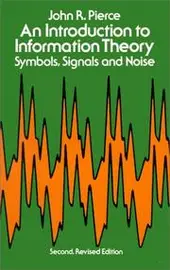 An introduction to information theoryJohn Robinson Pierce · 1980 · recommended by 15 people · similar by subject and what people say about it
 Information Theory, Inference & Learning AlgorithmsDavid J.C. MacKay · 2003 · recommended by 77 people · similar by subject and what people say about it
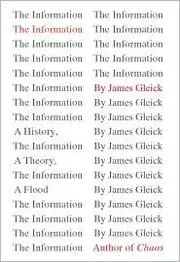 The InformationJames Gleick · 2011 · recommended by 61 people · similar by subject and what people say about it
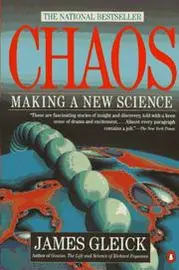 ChaosJames Gleick · 1987 · recommended by 45 people · similar by subject and what people say about it
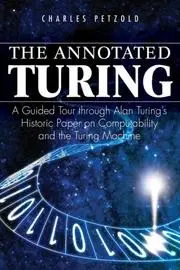 The Annotated TuringCharles Petzold · 2008 · recommended by 56 people · 2 people recommended both
 Introduction to the theory of computationMichael Sipser · 1997 · recommended by 66 people · similar by subject and what people say about it
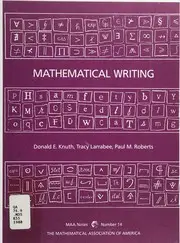 Mathematical writingDonald Knuth · 1988 · recommended by 11 people · similar by subject and what people say about it
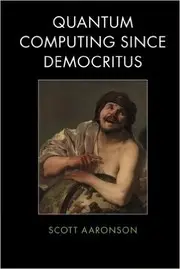 Quantum Computing Since DemocritusScott Aaronson · 2013 · recommended by 73 people · similar by subject and what people say about it
 Chaos making a new sciencejames gleick · 1987 · recommended by 22 people · similar by subject and what people say about it
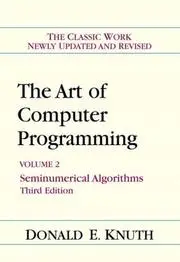 The art of computer programmingDonald Knuth · 1968 · recommended by 336 people · similar by subject and what people say about it
 Grammatical manJeremy Campbell · 1982 · recommended by 7 people · similar by subject and what people say about it
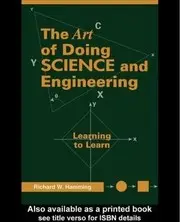 The art of doing science and engineeringRichard Hamming · 1996 · recommended by 56 people · similar by subject and what people say about it
 Computing machinery and intelligenceAlan Mathison Turing · 1981 · recommended by 10 people · similar by subject and what people say about it
 A new kind of scienceStephen Wolfram · 2002 · recommended by 44 people · similar by subject and what people say about it
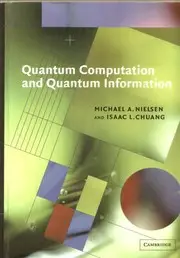 Quantum computation and quantum informationMichael A. Nielsen · 2000 · recommended by 30 people · similar by subject and what people say about it
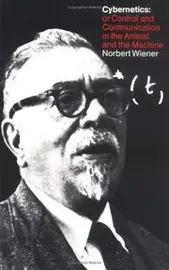 Cybernetics, or control and communication in the animal and the machineNorbert Wiener · 1948 · recommended by 4 people · similar by subject and what people say about it
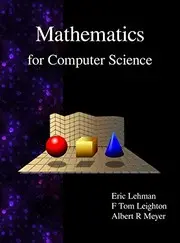 Mathematics for Computer ScienceEric Lehman · 2017 · recommended by 37 people · similar by subject and what people say about it
 Principia mathematicaAlfred North Whitehead · 1910 · recommended by 9 people · named together in 2 comments