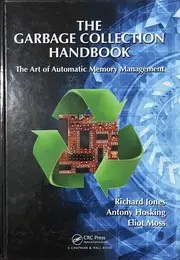
The garbage collection handbook
Jones, Richard · 2012
Programming and computer science › Compilers and interpreters
#1,106 most recommended
Hacker News
58
mentions by 34 people · top 6% of 15,732 books
Open Library
5.00★★★★★★★★★★
1 rating · 8 want to read
Wikipedia
—
No article yet
About the book
The book is a reference survey of automatic memory management, the techniques that let a runtime reclaim heap objects without programmer-directed deallocation. It covers tracing collectors (mark-sweep, copying, mark-compact), reference counting, generational schemes, and incremental, concurrent, parallel, and real-time collectors, along with the practical issues of allocation, roots, and interaction with compilers and runtimes. It is written for implementers and researchers who want more depth than a single paper offers. The book presents garbage collection as a design space rather than a single best algorithm, and it frames each collector as a set of trade-offs among throughput, pause times, space overhead, and locality. It treats tracing and reference counting as alternative answers to the same problem, and it shows how hybrid and specialised designs combine their strengths. Its central claim is that a collector suited to a given workload must be chosen by weighing these costs explicitly, not by default.
Written by Claude from what it knows of this book.
What Hacker News says 68% recommend · 0% critical
In the commenters’ own words
I was a Java true believer in the late 90s/early 2000s, working on LimeWire, the most popular Java desktop app at the time (maybe of all time?). I thought we…
The results from the "Compiler-Construction" are not good. You'll find better results from a search engine, Q&A site, or bookseller: Here are the top 10: #1…
What Open Library readers say 5.00 from 1 rating
- 51
- 40
- 30
- 20
- 10
- 8 want to read
- 0 reading
- 1 have read
Only 1 rating: treat the average as a hint.
What critics say, via Wikipedia
No Wikipedia article about this book yet, so no critics to quote.
Reddit communities — coming later
The threads it came up in
Details
- First published
- 2012
- ISBN
- 9781420082791
- Editions known
- 2 at Open Library
- Open Library
- OL16499934W
COMPUTERSComputer algorithmsGarbage collection (Computer science)GeneralGestion mémoire (Informatique)MATHEMATICSMemory management (Computer science)Memory management (computer science)Nettoyage de mémoire (Informatique)Programming Languages
Read next: its neighbours on the mosaic
 Garbage collectionJones, Richard · 1996 · recommended by 6 people · 2 people recommended both
 Computer architectureJohn L. Hennessy · 1989 · recommended by 59 people · 2 people recommended both
 Parsing TechniquesDick Grune · 2007 · recommended by 16 people · similar by subject and what people say about it
 Taligent's Guide to Designing ProgramsInc Taligent · 1994 · recommended by 1 person · similar by subject and what people say about it
 J for C Programmersrecommended by 17 people · 2 people recommended both
 Algorithms and data structuresNiklaus Wirth · 1986 · recommended by 8 people · similar by subject and what people say about it
 The art of computer programmingDonald Knuth · 1968 · recommended by 336 people · 4 people recommended both
 Compiler constructionNiklaus Wirth · 1996 · recommended by 30 people · 3 people recommended both
 C interfaces and implementationsDavid R. Hanson · 1996 · recommended by 46 people · similar by subject and what people say about it
 Modern CJens Gustedt · 2019 · recommended by 37 people · similar by subject and what people say about it
 Purely functional data structuresChris Okasaki · 1998 · recommended by 87 people · 3 people recommended both
 Program ConstructionRoland C. Backhouse · 2003 · recommended by 3 people · similar by subject and what people say about it
 Compilers, principles, techniques, and toolsAlfred V. Aho · 1986 · recommended by 195 people · 3 people recommended both
 The Practice of ProgrammingBrian W. Kernighan · 1999 · recommended by 90 people · 2 people recommended both
 Building an optimizing compilerRobert Morgan · 1998 · recommended by 5 people · loosely similar by subject
 Graphics gemsAndrew S. Glassner · 1990 · recommended by 15 people · similar by subject and what people say about it
 C Concurrency in ActionAnthony Williams · 2012 · recommended by 14 people · similar by subject and what people say about it
 Clean CodeRobert C. Martin · 2008 · recommended by 298 people · similar by subject and what people say about it
 Algorithms for Modern HardwareSergey Slotin · 2022 · recommended by 15 people · similar by subject and what people say about it
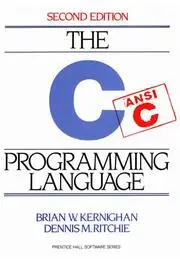 The C Programming LanguageBrian W. Kernighan · 1978 · recommended by 246 people · 2 people recommended both
 Solaris internalsRichard McDougall · 2006 · recommended by 4 people · 2 people recommended both
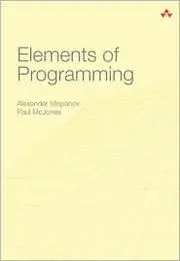 Elements of programmingAlexander A. Stepanov · 2009 · recommended by 31 people · similar by subject and what people say about it
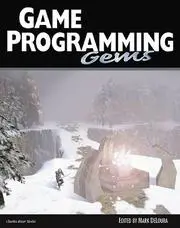 Game Programming GemsMark DeLoura · 2000 · recommended by 8 people · similar by subject and what people say about it
 From Mathematics to Generic ProgrammingAlexander A. Stepanov · 2015 · recommended by 12 people · similar by subject and what people say about it