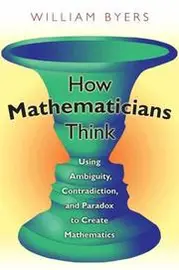
How Mathematicians Think
William Byers · 2006
Mathematics and physics › Mathematical philosophy and logic
#9,708 most recommended
Hacker News
4
mentions by 3 people · top 54% of 15,732 books
Open Library
5.00★★★★★★★★★★
1 rating · 9 want to read
Wikipedia
—
No article yet
About the book
A study of the mental processes behind mathematical discovery, covering how mathematicians form concepts, reason through them, and arrive at new results. Its scope spans pure mathematics and its history, with examples drawn from number systems, geometry, analysis, and set theory, written for general readers as well as students and teachers of mathematics. Byers contends that ambiguity, contradiction, and paradox are not defects to be removed from mathematics but the sources of its creativity and growth. He illustrates this with episodes such as the slow acceptance of negative and imaginary numbers, the use of infinitesimals, and the paradoxes that accompanied set theory, showing how confronting apparent inconsistency led to new concepts. From this he argues that mathematical understanding is an ongoing process of resolving tensions rather than the static accumulation of fixed truths, and that an accurate account of the subject should describe how mathematicians actually think.
Written by Claude from what it knows of this book.
What Hacker News says 100% recommend · 0% critical
In the commenters’ own words
Maybe not "made me better at math" per-se, but definitely "made me more enthusiastic about math": The Universe Speaks in Numbers [1] by Graham Farmelo I found…
That's a really good point. And it reminds me that there is a really cool book titled How Mathematicians Think [1] that goes into much detail about how…
What Open Library readers say 5.00 from 1 rating
- 51
- 40
- 30
- 20
- 10
- 9 want to read
- 1 reading
- 1 have read
Only 1 rating: treat the average as a hint.
What critics say, via Wikipedia
No Wikipedia article about this book yet, so no critics to quote.
Reddit communities — coming later
The threads it came up in
Details
- First published
- 2006
- ISBN
- 9780691145990
- Editions known
- 8 at Open Library
- Open Library
- OL8328732W
Cognition numeriqueHistory & PhilosophyHistory of Science and Medicine, Philosophy of ScienceMathematiciansMathematiciensMathematicsMathematics / HistoryMathematics, philosophyMathematiquesPhilosophiePhilosophyPhilosophy of mathematicsPopular sciencePsychological aspects
Read next: its neighbours on the mosaic
 How to think like a mathematicianKevin Houston · 2009 · recommended by 8 people · similar by subject and what people say about it
 Zen of Exotic ComputingPeter M. Kogge · 2022 · recommended by 1 person · similar by subject and what people say about it
 Mathematics, form and functionSaunders Mac Lane · 1986 · recommended by 12 people · similar by subject and what people say about it
 More Matrix and PhilosophyIrwin, William. · 2005 · recommended by 1 person · similar by subject and what people say about it
 Mathematics: Form and FunctionS. Maclane · 1986 · recommended by 3 people · loosely similar by subject
 Thinking in C++Bruce Eckel · 1995 · recommended by 11 people · loosely similar by subject
 Mathematical Thought from Ancient to Modern TimesMorris Kline · 1972 · recommended by 2 people · similar by subject and what people say about it
 CodersClive Thompson · 2019 · recommended by 4 people · loosely similar by subject
 The Mathematical ExperiencePhilip J. Davis · 1980 · recommended by 20 people · similar by subject and what people say about it
 Thinking about MathematicsStewart Shapiro · 2000 · recommended by 5 people · similar by subject and what people say about it
 Men of mathematicsEric Temple Bell · 1937 · recommended by 12 people · similar by subject and what people say about it
 What is mathematics, really?Reuben Hersh · 1997 · recommended by 4 people · similar by subject and what people say about it
 Where Mathematics Comes FromGeorge Lakoff · 2000 · recommended by 18 people · similar by subject and what people say about it
 The mathematician's mindJacques Hadamard · 1996 · recommended by 1 person · similar by subject and what people say about it
 How Not to Be WrongJordan Ellenberg · 2014 · recommended by 20 people · similar by subject and what people say about it
 Thoughtful Machine LearningMatthew Kirk · 2014 · recommended by 1 person · loosely similar by subject
 Philosophy of mathematicsStewart Shapiro · 1997 · recommended by 2 people · similar by subject and what people say about it
 Mathematics and its historyJohn C. Stillwell · 1989 · recommended by 15 people · similar by subject and what people say about it
 The Language of MathematicsKeith J. Devlin · 1998 · recommended by 3 people · similar by subject and what people say about it
 More Matrix and philosophyWilliam Irwin · 2005 · recommended by 1 person · loosely similar by subject
 Soar Cognitive ArchitectureJohn E. Laird · 2012 · recommended by 1 person · loosely similar by subject
 Thinking mathematicallyMason, John · 1982 · recommended by 4 people · similar by subject and what people say about it
 The Essence of Mathematics Through Elementary ProblemsAlexandre Borovik · 2019 · recommended by 2 people · similar by subject and what people say about it
 Mathematical peopleDonald J. Albers · 1985 · recommended by 1 person · similar by subject and what people say about it