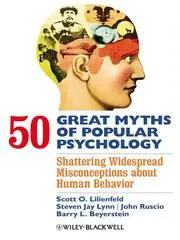
50 Great Myths of Popular Psychology
Scott O. Lilienfeld, Steven Jay Lynn, John Ruscio, Barry L. Beyerstein · 2009
Self-help, psychology and business books › Decision making and behavioral economics
#13,053 most recommended
Hacker News
2
mentions by 2 people · top 79% of 15,732 books
Open Library
—
No ratings yet
32 want to read
Wikipedia
132
article views a month
About the book
The book examines widely held beliefs about the mind and behavior that have little or no scientific support, such as opposites attract, people use only 10 percent of their brains, and handwriting reveals personality. Its scope covers everyday folk psychology, with fifty myths discussed in detail, a list of more than 200 further myths, and a closing set of surprising findings that turn out to be true. Its central claim is that many popular psychological beliefs persist despite contrary evidence, and that people can learn to separate scientific claims from pseudoscientific or fictional ones by applying critical thinking. The authors offer a mythbusting toolkit for evaluating folk psychology claims in daily life, and they show through each myth how anecdotes, selective memory, and media exaggeration make false ideas seem credible. The book also points readers to web resources for checking such claims independently.
Written by Claude from what it knows of this book.
What Hacker News says 50% recommend · 0% critical
In the commenters’ own words
Here's another paper, "Learning Styles - Concepts and Evidence": http://psi.sagepub.com/content/9/3/105.abstract I quote: "Although the literature on learning…
What Open Library readers say
No Open Library reader has rated it yet.
- 32 want to read
- 1 reading
- 0 have read
What Wikipedia says
- published 2009
- articles in 3 languages
- 132 views a month
Reddit communities — coming later
The threads it came up in
Details
- First published
- 2009
- ISBN
- 9781405131124
- Editions known
- 20 at Open Library
- Open Library
- OL15180180W
Critical thinkingHuman behaviorMisvattingenMänskligt beteendeNonfictionPopular psychologyPopular worksPopularpsychologiePopulärpsychologiePopulärvetenskapPsychologiePsychologyPsykologiVolksopvattingen
Read next: its neighbours on the mosaic
 The Cambridge handbook of expertise and expert performanceK. Anders Ericsson · 2006 · recommended by 14 people · similar by subject and what people say about it
 The myths of innovationScott Berkun · 2007 · recommended by 5 people · similar by subject and what people say about it
 Don't Believe Everything You ThinkJoseph Nguyen · 2022 · recommended by 1 person · loosely similar by subject
 A Whole New MindDaniel H. Pink · 2005 · recommended by 5 people · loosely similar by subject
 Get Out of Your Mind and Into Your LifeSteven C. Hayes · 2005 · recommended by 8 people · loosely similar by subject
 Managing Your MindGillian Butler · 1995 · recommended by 2 people · loosely similar by subject
 Learned OptimismMartin Elias Pete Seligman · 2006 · recommended by 56 people · similar by subject and what people say about it
 A Liberated MindSteven C. Hayes · 2019 · recommended by 5 people · loosely similar by subject
 The Happiness TrapRuss Harris · 2007 · recommended by 22 people · loosely similar by subject
 Psycho-cyberneticsMaxwell Maltz · 1960 · recommended by 21 people · similar by subject and what people say about it
 DriveDaniel H. Pink · 2009 · recommended by 47 people · loosely similar by subject
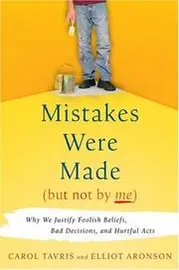 Mistakes Were MadeCarol Tavris · 2007 · recommended by 18 people · similar by subject and what people say about it
 The social animalElliot Aronson · 1972 · recommended by 6 people · similar by subject and what people say about it
 Psychology and lifeRichard J. Gerrig · 2004 · recommended by 2 people · similar by subject and what people say about it
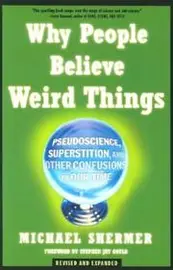 Why people believe weird thingsMichael Shermer · 1997 · recommended by 9 people · similar by subject and what people say about it
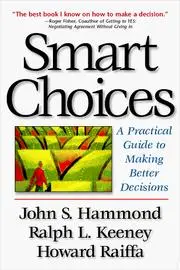 Smart choicesHammond, John S. · 1998 · recommended by 1 person · loosely similar by subject
 Better Never to Have BeenDavid Benatar · 2006 · recommended by 9 people · loosely similar by subject
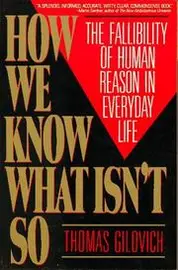 How we know what isn't soThomas Gilovich · 1991 · recommended by 3 people · similar by subject and what people say about it
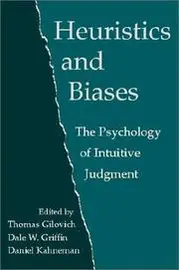 Heuristics and biasesThomas Gilovich · 2002 · recommended by 5 people · similar by subject and what people say about it
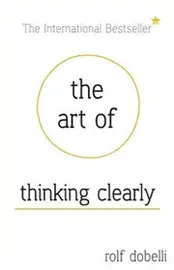 The art of thinking clearlyRolf Dobelli · 2013 · recommended by 15 people · similar by subject and what people say about it
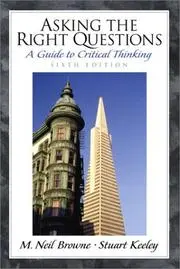 Asking the right questionsM. Neil Browne · 1981 · recommended by 2 people · similar by subject and what people say about it
 The believing brainMichael Shermer · 2011 · recommended by 4 people · similar by subject and what people say about it
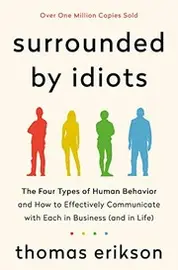 Surrounded by IdiotsThomas Erikson · 2014 · recommended by 1 person · similar by subject and what people say about it
 Why smart people make big money mistakes--and how to correct themGary Belsky · 1999 · recommended by 3 people · similar by subject and what people say about it